
How to Study Like You’ll Actually Be Tested

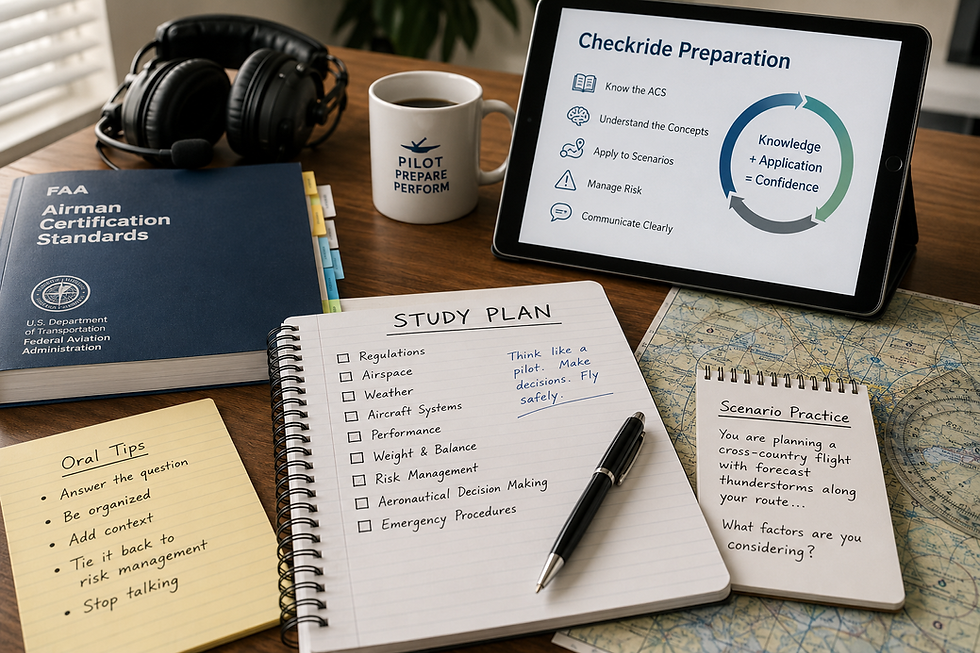
Preparing for a checkride can feel overwhelming because there is so much material available. You have the ACS, FAA handbooks, regulations, advisory circulars, charts, weather products, aircraft systems, performance charts, limitations, emergency procedures, and probably a few notes from your instructor written in the margin of your notebook.
The challenge is not just studying more. The challenge is studying in a way that matches how the checkride actually works.A checkride is not a trivia contest. It is not designed to see whether you can recite random facts in isolation. The examiner is evaluating whether you can apply your knowledge, make safe decisions, recognize risk, and explain your reasoning clearly.
That means your checkride prep should go beyond memorization. You need to practice connecting facts to real scenarios.
Start With the ACS, Not a Random Study Guide
The FAA Airman Certification Standards should be the foundation of your preparation. The ACS tells you what areas of operation, tasks, knowledge elements, risk management elements, and skills may be evaluated.
Many applicants make the mistake of studying broadly without knowing exactly what they are trying to satisfy. They bounce between videos, flashcards, old gouge, and instructor notes without anchoring their preparation to the standard.
A better approach is to use the ACS as your map.
For each task, ask yourself:
Can I explain the required knowledge in plain language?
Can I apply it to a realistic flight scenario?
Can I identify the risk management considerations?
Can I describe what I would do as pilot in command?
This approach keeps your studying focused. It also helps prevent the common problem of knowing a fact but not knowing when or why it matters.
Practice Scenario-Based Answers
Most examiners do not simply ask, “What is the definition of hypoxia?” and move on.They are more likely to ask questions that require you to apply that knowledge.
For example:
“You are planning a night cross-country at 9,500 feet with passengers. What would you be thinking about from an oxygen and risk management standpoint?”
That question is testing more than one thing. It may involve regulations, human factors, night operations, passenger safety, personal minimums, and aeronautical decision-making. A strong answer does not need to be long. It needs to be organized.
For example:
“First, I would look at the regulatory oxygen requirements under 91.211. At 9,500 feet, supplemental oxygen is not legally required for a normal unpressurized flight, but I would still consider the physiological risk, especially at night. Vision can be affected by mild hypoxia, and passengers may tolerate altitude differently. I would also consider fatigue, terrain, weather, and whether a lower altitude would be safer or more comfortable.”
That answer shows knowledge, judgment, and practical application. It sounds like a pilot thinking through a flight, not someone reciting a flashcard.
Learn to Answer Clearly Without Over-Talking
One of the most common checkride problems is not lack of knowledge. It is over-answering. Applicants often know the answer, but they keep talking until they wander into something incorrect. This can create unnecessary follow-up questions and make the examiner wonder whether the applicant really understands the topic.
A good checkride answer should usually do three things:
Answer the question directly.
Add the necessary explanation or context.
Stop when the answer is complete.
For example, if the examiner asks, “What documents are required to be on board the aircraft?” you do not need to launch into a ten-minute discussion about aircraft certification history.
A clean answer might be:
“The required documents are commonly remembered as ARROW: airworthiness certificate, registration, radio station license if required for international operations, operating limitations, and weight and balance information.”
That is direct, complete, and controlled. If the examiner wants more, they will ask.
Study Weak Areas Early
It is natural to study the topics you already understand. It feels productive because you can move quickly and get answers right. But checkride readiness improves the most when you identify weak areas early and work through them deliberately. If you are uncomfortable with airspace, weather interpretation, aircraft systems, performance calculations, or regulations, do not save those topics for the final days before your test. Those are exactly the areas that need time, repetition, and scenario-based practice.
A good rule is this: if you hope the examiner does not ask about a topic, that topic should move to the top of your study list. Weak areas become much less intimidating once you break them into smaller pieces. Instead of saying, “I’m bad at weather,” separate the topic into METARs, TAFs, prog charts, AIRMETs, SIGMETs, convective outlooks, ceilings, visibility, winds aloft, and go/no-go decision-making.
Then work one piece at a time.
Tie Everything Back to Safety
The examiner is not just listening for correct answers. They are listening for safe thinking. Whenever possible, connect your answers back to risk management and decision-making.
For example, if you are discussing weight and balance, do not stop at the calculation. Explain what the result means. How does an aft center of gravity affect stability? How might weight affect takeoff distance, climb performance, or landing distance? What would you do if the numbers were close to a limitation?
If you are discussing weather, do not just decode the forecast. Explain whether the flight is safe, legal, and within your personal minimums. If you are discussing aircraft systems, do not just name the components. Explain what indications you would expect, what failures might look like, and how you would respond.
This is where many applicants separate themselves. They move from “I memorized the material” to “I can use this information as a pilot.”
Do Mock Orals Before You Feel Ready
Many applicants wait too long to practice the oral portion. They keep studying privately because they want to feel fully prepared before answering questions out loud. The problem is that speaking through an answer is a different skill than reading or highlighting.
You may understand a topic internally but struggle to explain it clearly. You may know the regulation but not know how to apply it to a scenario. You may discover that your answers are too long, too vague, or missing the risk management piece.
That is exactly why mock oral practice is valuable.
Mock oral sessions reveal the gaps that normal studying can hide. They also help you get more comfortable with the rhythm of the checkride: listen, think, answer, clarify, and move on. The goal is not perfection. The goal is progress.
Build a Final-Week Review Plan
In the final week before your checkride, your study plan should become more focused. This is not the time to randomly consume new material for hours at a time. Instead, organize your review around the ACS, your aircraft, and your known weak areas.
A strong final-week plan might include:
Reviewing one or two ACS areas of operation each day.
Practicing short, scenario-based oral answers.
Reviewing aircraft systems, limitations, and performance.
Chair-flying practical scenarios.
Reviewing missed questions or weak topics from mock oral practice.
Getting enough sleep.
That last one matters. Fatigue makes it harder to think clearly, retrieve information, and manage stress. A checkride is a performance event. Your preparation should support that.
Confidence Comes From Repetition
Confidence on checkride day does not come from hoping the examiner asks easy questions. It comes from having practiced enough realistic scenarios that you trust your ability to work through the question. You do not need to know everything perfectly. You need to know the required material, understand how to find reliable information, apply good judgment, and communicate like a safe pilot.
When you study that way, the checkride becomes less mysterious. It becomes what it is supposed to be: an opportunity to demonstrate that you are ready for the certificate or rating you have worked hard to earn.
The best checkride preparation is not just about passing. It is about becoming the kind of pilot who can explain decisions clearly, manage risk thoughtfully, and keep learning after the temporary certificate is printed.
A focused, scenario-based study plan can make all the difference.
AeroPrep Labs helps you practice realistic, ACS-driven oral scenarios so you know what to say, how to say it, and why it matters.
Get started: aeropreplabs.com/programs

Comments